
Why Professional Nail Products Cost More: A 2026 Guide
Table of Contents
- The Real Cost Breakdown of Professional Nail Products
- Difference Between Professional and Retail Nail Polish: What You're Paying For
- FDA Regulations for Nail Product Ingredients and Safety Standards
- The Hidden Cost of Cheap Products on Your Salon's Reputation
- How to Buy Professional Grade Acrylic Powder Online Without Overpaying
- Cost-Per-Service: Pricing Your Work to Cover Quality Supplies
- Conclusion: Investing in Your Craft and Your Clients
- Frequently Asked Questions
Last Updated: September 9, 2026
The Real Cost Breakdown of Professional Nail Products
Walk into any salon supply store and you will see a dramatic price gap between the drugstore shelf and the professional counter. That gap often confuses clients and new technicians alike, which is exactly why professional nail products cost more than their retail counterparts. The pricing difference comes down to chemistry, regulation, and business reality rather than simple markup.
The first thing to understand is that you are not paying for a prettier bottle. The higher price reflects research and development, quality control testing, and the raw material costs of ingredients that must perform under demanding conditions. Professional products must cure evenly under lamp light, resist lifting for weeks, and maintain pigment concentration through heavy use. These performance standards require formulation expertise that budget brands simply do not invest in.
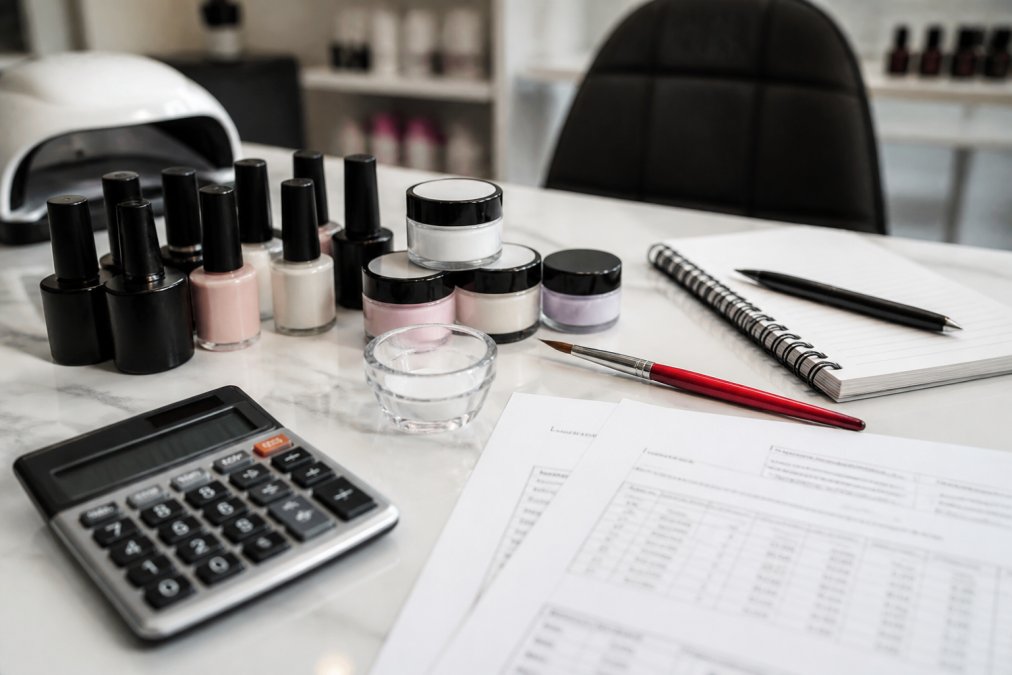
When you break down the price per use, the picture changes considerably. A bottle of professional gel polish might seem expensive at first glance, but it delivers dozens of services. Retail polish that chips within days forces redo appointments and eats into your profit margin through wasted product and client frustration.
Difference Between Professional and Retail Nail Polish: What You're Paying For
The difference between professional and retail nail polish is visible within the first week of wear. Professional formulas use higher pigment concentration, which means richer color in fewer coats and a more durable finish that resists chipping and smudge-resistant properties that last through daily wear.
Retail polish is designed for occasional home use, not for the demands of service longevity in a salon environment. The monomer and polymer ratios in professional acrylics, along with the photo-initiators in gel systems, are calibrated for consistent curing under professional lamps. Cheap alternatives often fail to cure properly, leading to lifting, breakage, and unhappy clients who will not return.
Professional-grade products also account for chemical safety in their formulation. They are tested for dermatological safety and compatibility with curing lamp systems, reducing the risk of allergic reactions that can damage your reputation. When you buy professional products, you are paying for predictable performance that protects your client relationships.

FDA Regulations for Nail Product Ingredients and Safety Standards
Many technicians do not realize that nail products fall under the regulatory oversight of the U.S. Food and Drug Administration (the FDA). The FDA regulatory framework for cosmetics and nail products treats nail polish, acrylics, and gels as cosmetics under the Federal Food, Drug, and Cosmetic Act. This means the FDA does not pre-approve products before they hit the market, the burden falls on manufacturers to ensure their products are safe and properly labeled.
What separates professional-grade manufacturers from budget brands is how they respond to that regulatory reality. While the FDA does not require pre-market safety testing for cosmetics, professional manufacturers typically conduct voluntary safety assessments and stability testing that go far beyond baseline compliance. This includes:
- Dermatological patch testing to screen for sensitization and allergic reactions, often conducted by independent labs at costs ranging from several thousand dollars per formulation.
- Stability and compatibility testing to verify that gels cure properly under a range of professional lamps and that pigments do not degrade or shift color over time.
- Ingredient purity verification through certificates of analysis from raw material suppliers, ensuring that each batch meets specification before it enters production.
- Batch-to-batch consistency testing to confirm that the product you receive in March performs identically to the batch from September.
Professional manufacturers also maintain full supply chain documentation, including Material Safety Data Sheets (MSDS) for every product. These documents are not just paperwork, they are the records you need if a client develops a reaction and you must identify exactly what was in the product you applied. Retail brands and gray-market imports often cannot produce this documentation because they do not maintain the same quality control systems.
The cost of this compliance is real and measurable. A single stability testing protocol can take months and cost thousands of dollars per formulation (peer-reviewed research). When a manufacturer reformulates a product, even to change a single pigment, the testing cycle starts over. These costs are baked into the wholesale price, and they are the reason professional products carry a premium.
Beyond FDA oversight, professional manufacturers often pursue voluntary certifications that add another layer of cost. Many professional brands formulate to meet the stricter standards of the European Union's cosmetics regulation, which restricts more than 1,300 ingredients compared to the roughly 11 ingredients the FDA explicitly prohibits or restricts in cosmetics. This voluntary compliance means professional products are often formulated to a higher safety standard than the law requires, and that formulation work costs money.
For the working technician, the practical takeaway is this: when you buy professional-grade products, you are purchasing documented safety, batch consistency, and regulatory diligence. That traceability is part of what you are paying for, and it is the difference between a product you can defend and a product you can only hope will work.
The Hidden Cost of Cheap Products on Your Salon's Reputation
The cheapest acrylic powder or gel polish on the market can cost you far more than the money you save. A single service failure, whether it is premature lifting, discoloration, or a client reaction, can undo months of trust-building in seconds. Client retention depends on consistent results, and consistency is difficult to achieve with products that vary between batches.
Cheap products also cost you time. Poorly formulated acrylics may not self-level correctly, requiring extra filing and rework. Gels with weak photo-initiators need longer curing times, slowing your appointment schedule and reducing your daily revenue potential. The overhead costs of salon operations mean every wasted minute directly hits your bottom line.
What most guides miss is the burnout factor. When products fight you during application, the work becomes exhausting. Professional-grade supplies are designed to behave predictably, which protects your hands, your wrists, and your enthusiasm for the craft. professional styling tools.
How to Buy Professional Grade Acrylic Powder Online Without Overpaying
Buying professional grade acrylic powder online requires knowing exactly what you are looking for and where to find authentic stock. The first rule is to verify your supplier only sells to licensed professionals, which filters out gray-market distributors who cannot guarantee product authenticity.
Look for suppliers that carry established industry brands with full product documentation. A legitimate professional supplier will offer consistent inventory, proper storage, and reasonable shipping times because they depend on repeat orders from working technicians. Beauty Zone Nail Supply, for example, stocks an extensive selection of professional nail brands and offers overstock deals and monthly salon specials that make quality supplies more affordable.

When comparing prices, calculate the cost-per-application rather than the bottle price. A premium acrylic system that applies smoothly and lasts three weeks between fills is cheaper than a budget system that requires constant repairs. Factor in your labor time and the value of a satisfied client who books again.
Cost-Per-Service: Pricing Your Work to Cover Quality Supplies
The most common mistake independent technicians make is pricing services based on what competitors charge rather than what the service actually costs to deliver. A proper cost-per-service calculation includes product consumed, disposable supplies, electricity for lamps and drills, and your labor time. But the real gap in most pricing guides is the math, so let's walk through it with real numbers.
The gel polish example. A professional gel polish bottle typically contains 0.5 oz (15 mL) and costs between $15 and $25 wholesale. A single full manicure uses approximately 0.5 to 1 mL of color depending on application technique and number of coats. That means one bottle delivers roughly 15 to 30 full manicures. At a $20 wholesale cost and 20 services per bottle, the product cost per client is $1.00. Compare that to a $6 retail polish that chips in three days, if a client returns for a redo, product, time, and lamp electricity are consumed with zero additional revenue.
The acrylic system example. Professional acrylic powder costs roughly $12 to $18 per 4 oz jar. A full set consumes about 0.2 to 0.3 oz of powder depending on the size and technique. That translates to roughly 15 to 20 full sets per jar, putting the powder cost per service between $0.60 and $1.20. Add monomer at approximately $0.30 to $0.50 per service, and the total acrylic product cost lands around $1.00 to $1.70 per full set.

The full picture. Now add the other consumables that often get overlooked:
| Supply Item | Cost Per Service (Approximate) |
|---|---|
| Professional gel polish | $0.80 - $1.50 |
| Acrylic powder + monomer | $1.00 - $1.70 |
| Primer, dehydrator, and bonder | $0.20 - $0.40 |
| Files, buffers, and disposable supplies | $0.50 - $1.00 |
| Lamp electricity and drill bits | $0.10 - $0.30 |
| Total product and supply cost | $2.60 - $4.90 per service |
When charging $60 for a gel manicure, supplies represent roughly 4% to 8% of the service price. That is a remarkably small fraction, and it is the reason professional products are not the place to cut corners. Even if product cost doubled by using premium lines, the margin impact is minimal compared to the cost of a failed service.
The rework math. Now factor in the failure rate. A budget gel polish that lifts or chips in five days instead of three weeks will generate redo appointments. A single redo consumes the same product and supplies but produces zero additional revenue. If 10% of your services fail with cheap products versus 2% with professional products, the math becomes stark. On a $60 service, ten failed services per hundred cost $600 in lost labor and product. Professional products effectively insure against that loss.
Client education scripts. The other half of cost-per-service is communicating value without losing clients. Here are three scripts that work:
- The longevity script: "I use professional-grade products that are formulated to last three weeks without lifting. That is why my sets cost a bit more than a discount salon, you are paying for results that last, not for a polish that chips in a few days."
- The safety script: "The products I use are FDA-regulated and manufactured with strict quality control. I can show you the safety documentation for anything I put on your nails. That traceability protects you and it protects my license."
- The investment script: "Think of it as cost per week. A $60 gel manicure that lasts three weeks is $20 per week. A $35 manicure that lasts five days is $49 per week, and you have to come back twice as often."
Conclusion: Investing in Your Craft and Your Clients
The price difference between professional and retail nail products reflects real differences in formulation, safety testing, and performance reliability. For working technicians, those differences translate directly into client satisfaction, repeat bookings, and a sustainable income. Cutting corners on supplies to save a few dollars per service is a false economy that costs far more in rework and lost trust.
Every service you perform carries your name and your reputation. Professional nail products from a supplier that serves licensed technicians protect both. Whether you need a reliable source for professional-grade acrylics and gels or the right tools to apply them, working with a distributor that understands the craft makes the investment worthwhile. Shop professional supplies that keep your salon at the forefront of beauty trends and your clients coming back.
Frequently Asked Questions
Why are professional nail products more expensive than drugstore brands?
Professional nail products cost more because they contain higher-grade pigments, more effective photo-initiators, and safer monomer/polymer systems than retail alternatives. These ingredients deliver better adhesion, longer wear, and reduced lifting. Brands also invest heavily in quality control and testing to ensure consistent performance, which adds to the cost. Retail polishes often use lower pigment concentration and cheaper solvents, which explains the price difference you see on the shelf.
How does the cost of professional supplies impact salon service pricing?
Professional supplies typically represent 5-10% of a salon's total service price. For example, a professional gel polish that lasts 3 weeks without chipping might have a cost-per-service of only about $1.50 to $2.00 across 6-8 clients. This small per-service cost allows you to charge premium prices while maintaining healthy profit margins and protecting your reputation through consistent, high-quality results.
Are professional-grade acrylic powders safer for natural nails?
Professional-grade acrylic powders typically use purer monomers and polymers that cure more completely and contain fewer uncured residuals that can cause contact dermatitis. Retail kits often use lower-quality liquid monomers with higher levels of potentially irritating additives. For licensed professionals, using FDA-compliant professional products reduces the risk of allergic reactions and lifting, which protects both your clients' natural nails and your liability.
Why do professional nail distributors require a license to purchase?
Professional nail distributors require a license to ensure products are used by trained technicians who understand proper application and curing protocols. This protects end consumers from misuse of professional-grade chemicals and helps maintain industry safety standards. It also allows distributors to offer products with higher concentrations of active ingredients that require professional knowledge to apply safely.