

Top Rated Professional Nail Salon Equipment for 2026
Table of Contents
- Quick Comparison: Top Rated Professional Nail Salon Equipment
- Best Professional Nail Drill for Salon Use: Power and Precision
- UV/LED Lamps: Curing Efficiency That Saves Time
- Nail Salon Ventilation Requirements: Dust Collectors That Protect
- Professional Nail Salon Furniture Packages: Layout and Client Comfort
- Sterilization and Sanitation: Non-Negotiable Safety Standards
- How We Evaluated and Which Equipment You Should Prioritize
- Conclusion: Build Your Salon with the Right Tools
- Frequently Asked Questions
Last Updated: September 6, 2026
Professional nail salons run on more than talent. The equipment you choose determines your service speed, your clients' comfort, and the long-term health of your own hands and wrists. At Beauty Zone Nail Supply, we have curated the essential gear that separates efficient, safe salons from those struggling with downtime and inconsistent results.
Below, we break down the equipment categories that matter most, what to look for in each, and where your budget delivers the most impact.
Quick Comparison: Top Rated Professional Nail Salon Equipment
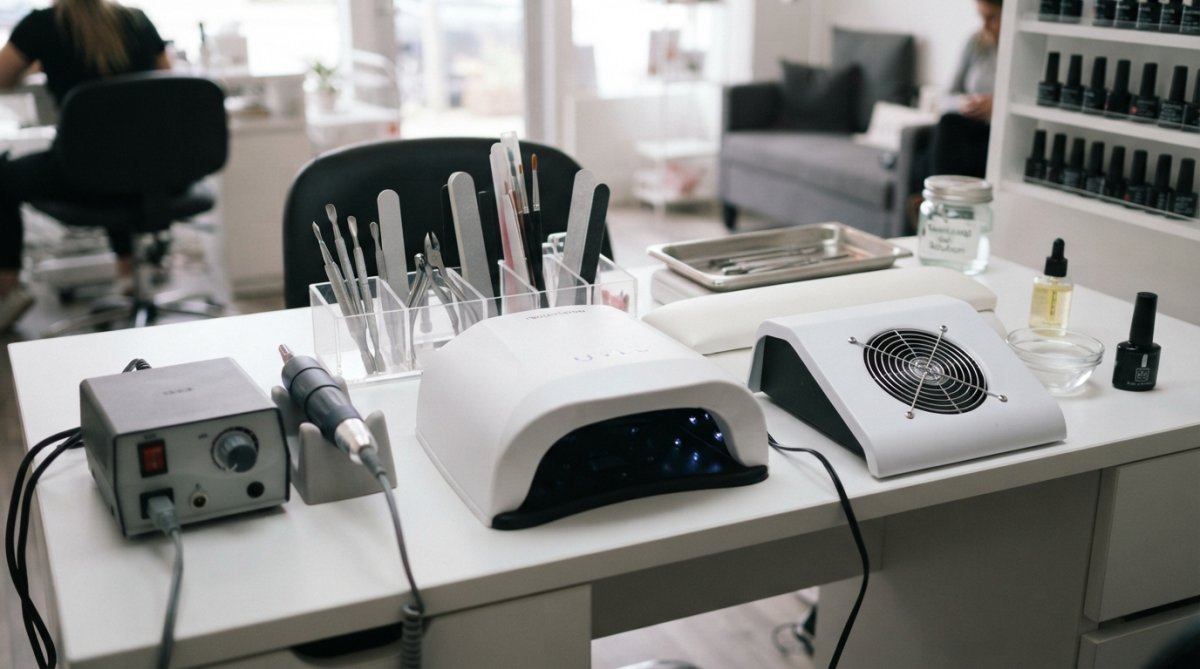
Before we examine each category, here is a snapshot of the core equipment every professional station needs, with the specific models we recommend and what they cost. These picks balance performance, durability, and price for working technicians.
Equipment Type |
Recommended Model |
Price |
Best For |
|---|---|---|---|
Electric Nail Drill |
Professional Nail Drill Machine 25000 RPM |
$25.00 |
Techs needing a reliable corded file with foot pedal control |
Cordless Nail Drill |
Monika Rechargeable Electric Nail Drill up 35K |
$70.00 |
Mobile techs and those who want maximum portability |
UV/LED Lamp |
$65.00 |
Fast, even curing without a cord getting in the way |
|
Dust Collector |
$48.00 |
Protecting lungs and keeping the workspace clean |
|
Sterilizer Jar |
Sterilizer Jar 25 oz |
$12.00 |
Safe tool storage between sanitation cycles |
Best Professional Nail Drill for Salon Use: Power and Precision
The nail drill is the workhorse of any acrylic or gel service. It needs consistent speed control, low vibration, and enough torque to remove product without generating excessive heat. Many techs buy the cheapest corded model, only to replace it within months when the motor burns out.

For most salon work, a variable-speed drill in the 25,000 to 35,000 RPM range covers every service. The Professional Nail Drill Machine 25000 RPM delivers this range with both hand and foot pedal modes, plus six drill bits and sanding bands included at $25.00.
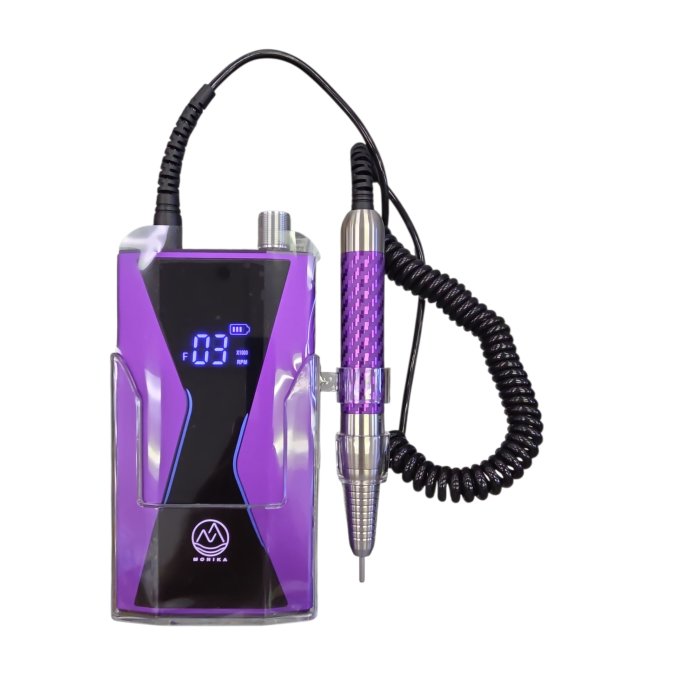
If you work mobile, the Monika Rechargeable Electric Nail Drill Machine up 35K hits 35,000 RPM with a Type-C charge and sells for $70.00. The convenience cost is real, but the freedom of movement during a fill or sculpt is worth it for techs who travel.
UV/LED Lamps: Curing Efficiency That Saves Time
Curing time is the hidden tax on every gel service. A slow lamp adds minutes per client, which adds up to lost appointments across a day. The current generation of UV/LED lamps cures most gel formulas in 30 to 60 seconds per layer.
The Monika LED/UV Advanced Cordless Lamp 72 W is our pick for most stations. At 72 watts, it cures gel polish, builder gels, and hard gels evenly without the heat spike that lower-quality lamps can cause. Its 15,600 mAh battery provides up to 12 hours of wireless work, and it offers timer settings of 10, 30, 60, or 99 seconds for low-heat curing. At $65.00, it replaces both a corded lamp and the need to schedule services around an outlet.
Wattage matters more than brand when comparing lamps. A 72W unit cures faster and more evenly than a 36W unit, reducing the risk of under-cured gel that peels or lifts days later.
Nail Salon Ventilation Requirements: Dust Collectors That Protect
Filing acrylic, gel, and natural nails produces fine dust that technicians inhale all day, every day. A dedicated nail dust collector positioned at the workstation captures particles at the source before they reach your breathing zone. This is one piece of equipment where cutting corners affects your health, not just your service quality.
The Monik D40 Nail Dust Collector sits beside your client's hand and pulls dust and debris away as you file, collecting everything in a reusable pouch for easy disposal. At $48.00, it is a modest investment against years of airborne particle exposure. For smaller stations or mobile setups, the Salon Nail Dust Collector Small offers the same capture principle in a more compact footprint at $45.00.
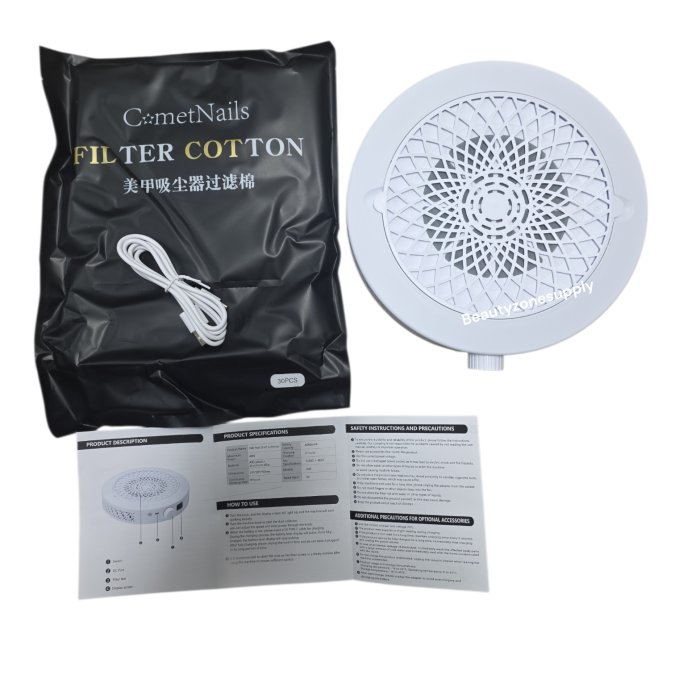
Monika D40 Nail Dust Collector
Position the collector within six inches of the nail you are filing for maximum capture. Clean the reusable pouch daily and replace the filter per the manufacturer's schedule to maintain suction power.
Professional Nail Salon Furniture Packages: Layout and Client Comfort
Professional nail salon furniture packages do more than make your space look polished. The right layout reduces fatigue for you and improves the experience for your client. The deeper issue, one that most equipment guides ignore, is the long-term musculoskeletal health of the technician. A poor setup doesn't just cause a sore back; it compounds into career-ending injuries.
The Ergonomic Case for Purpose-Built Furniture
The repetitive motions of filing, buffing, and polishing, combined with static posture, put nail technicians at high risk for work-related musculoskeletal disorders (WMSDs). The U.S. Bureau of Labor Statistics consistently ranks nail salon workers among those with high rates of overuse injuries (bls.gov). While state cosmetology boards regulate sanitation, they rarely mandate ergonomic standards, leaving the responsibility on you.
A proper pedicure chair with a spa basin supports client posture during long soaks. But the more critical piece is your own seating. An adjustable, ergonomic technician stool is a primary tool for injury prevention. Look for a stool with a pneumatic gas lift for height adjustment, a seat pan that tilts forward slightly to maintain the natural curve of your lower back, and a foot ring to support your feet.
The 90-Degree Rule and Workstation Geometry
The core ergonomic principle is the 90-degree rule. When seated and working, your elbows should be bent at a 90-degree angle, with your forearms parallel to the floor. Your wrists should be in a neutral position, and your feet should rest flat on the floor or on the stool's foot ring. If you are reaching up, slouching down, or bending your wrists to work, your table or chair height is wrong.
Measure your ideal working height before you buy furniture. Sit in a chair with your arms at your sides and elbows bent to 90 degrees. Measure the distance from the floor to your elbow; that is your target table height. Most standard manicure tables are built for standing or for taller technicians, which is why many working techs find them too high. Adjustable-height tables are the safest investment, as they accommodate multiple techs sharing a station.
Layout Zones for Workflow and Safety
Think in zones when planning your salon layout. The pedicure area needs space for the chair, your stool, and access to a sink or basin. The manicure station needs a table with drawers for tools, an adjustable technician stool, and task lighting. The Nail Table Energy Saving Desk Lamp 20W, priced at $4.00, provides bright, consistent illumination for detailed work and mounts with a universal table clamp that fits most manicure tables.
Beyond the immediate work surface, plan for movement. A common pattern in efficient salons is a 'supply triangle', the distance between your client's hand, your tool cart, and your sanitation station should be minimized to reduce twisting and reaching. A rolling cart placed within arm's reach eliminates the need to get up and down constantly. non-toxic nail polish.
A Note on Client Comfort
Client comfort is also a factor in your bottom line. A pedicure chair that is uncomfortable or a manicure table that is too high for the client to rest her arms naturally will lead to shorter visits and fewer return bookings. Look for chairs with lumbar support and armrests, and ensure your manicure table has a padded armrest for the client.
Sterilization and Sanitation: Non-Negotiable Safety Standards
Sanitation protocols in a nail salon protect your clients and your license. Every state board has specific requirements for tool disinfection, and falling short can mean fines, suspension, or worse. The equipment you choose must support a workflow that is easy to follow consistently.
Your sanitation station needs three tiers: a pre-cleaning step to remove visible debris, an intermediate disinfectant soak, and a final sterilization step for metal tools. An autoclave is the gold standard for sterilization of metal implements like cuticle nippers and bits (osha.gov). For tools that cannot withstand autoclave heat, an EPA-registered hospital-grade disinfectant with the appropriate contact time is required (the EPA).
The Sterilizer Jar 25 oz, priced at $12.00, serves the intermediate step: holding tools in disinfectant solution between clients. For the final sterilization step, invest in a tabletop autoclave that meets your state board's requirements. Check your state's cosmetology board regulations for the exact standards that apply to your license type.
How We Evaluated and Which Equipment You Should Prioritize
We evaluated this equipment based on four criteria: reliability under daily professional use, safety features that protect both technician and client, price relative to performance, and how well each item integrates into a real salon workflow. We did not include disposable or novelty items that lack professional-grade durability.
Choosing equipment is a business decision with direct implications for your revenue, your service pricing, and your ability to scale. Most equipment guides stop at 'buy this, not that.' Here is the 'why' and 'how' that most guides miss.
The ROI of Speed and Reliability
Your equipment is a revenue engine. Every minute you spend fighting a slow lamp, a vibrating drill, or a clogged dust collector is a minute you are not spending on a paying service. If a slow UV/LED lamp adds two minutes to every gel cure, and you do ten gel services a day, that is twenty minutes of lost production time daily. Over a five-day week, that is nearly two hours of potential revenue lost. A faster lamp that costs $65 can pay for itself in a matter of weeks.
Similarly, a drill with consistent torque and low vibration reduces the time you spend on filing and finishing. A drill that vibrates excessively forces you to work slower to maintain control, and it can cause hand fatigue that slows you down for the rest of the day.
Matching Equipment to Salon Size and Growth Projections
The right equipment for a solo technician working from a rented chair is different from the right equipment for a five-station salon. Before you buy, project your revenue growth over the next 12 to 24 months. If you are planning to add a second technician, you will need a second set of core tools, drill, lamp, dust collector, which means your initial budget should prioritize those items over furniture upgrades.
A common pattern for growing salons is to start with a single high-quality station and expand outward. The mistake is buying the cheapest possible version of everything to equip multiple stations at once, only to replace those tools within a year. A better strategy is to buy fewer, higher-quality items and add stations as revenue justifies it.
The Hidden Cost of Downtime
When evaluating equipment, factor in the cost of downtime. A drill that burns out in six months means a service interruption, a frustrated client, and an emergency replacement purchase at full retail price. A lamp that fails mid-service means a redo and a lost appointment slot. Reliability is not just a convenience; it is a financial hedge.
A Prioritization Framework for New Salons
If you are equipping a new salon on a budget, prioritize in this order, based on revenue impact and regulatory necessity:
- The Nail Drill and Bits: You cannot perform most services without it. This is your primary revenue tool.
- The UV/LED Lamp: Uncured gel means redo services and lost revenue. A fast, reliable lamp is non-negotiable.
- The Dust Collector: Your long-term health depends on it. This is a non-negotiable investment in your career longevity.
- Sterilizer and Sanitation Supplies: You cannot legally operate without them. This is a compliance cost, not a discretionary purchase.
- Furniture and Comfort Items: These can be upgraded as revenue grows. A basic table and chair will work for a few months; a poor drill or lamp will cost you money immediately.
For existing salons, audit your current equipment against this list. If your drill vibrates excessively or your lamp takes over two minutes to cure a layer, replacement will pay for itself in faster services and fewer client complaints. Track your service times for a week. If you are consistently running over your scheduled appointment length, your equipment is likely the bottleneck.
:::takeaway Think of equipment as a capital investment, not an expense. Every tool should either generate revenue, protect your health, or keep you compliant. If it does none of those things, it is not worth the space in your salon.
Conclusion: Build Your Salon with the Right Tools
Equipping a professional salon is a sequence of decisions, each one affecting your service speed, client satisfaction, and your own physical health. Start with the tools that touch every service: a reliable drill, a fast curing lamp, and a dust collector that protects your lungs. Add sanitation equipment that meets your state board's standards, then build out your furniture for comfort and efficiency.
Beauty Zone Nail Supply carries the professional-grade equipment and supplies you need, from nail drills and UV/LED lamps to sterilizers and workstation accessories. Our selection is intended for licensed professional use, and our team understands the demands of a working salon. Shop the full equipment range at Beauty Zone Nail Supply and outfit your station with tools that perform as hard as you do.
Frequently Asked Questions
What brands do professional nail techs use?
Professional nail techs typically choose equipment that balances durability, performance, and price. In the drill category, Monika models are popular for their 35,000 RPM motors and cordless options. For curing, the Monika 72W LED/UV lamp is a trusted choice. Adventek dust collectors are standard for ventilation. Rather than focusing on a single brand, look for professional-grade specifications like adjustable speed and wattage that match your service menu.
What equipment does a professional nail tech need?
A professional nail tech needs a reliable electric nail file with variable speed, a high-wattage UV/LED lamp for gel curing, a dust collector to manage filings, and proper sanitation tools like a sterilizer jar. Furniture like an ergonomic stool and a manicure table is essential for client comfort and your own posture. A starter kit with a drill, bits, and sanding bands helps you serve clients immediately.
How do I choose the best professional nail drill for salon use?
Look for a drill with a brushless motor and a speed range between 20,000 and 35,000 RPM. A foot pedal gives you precise control during acrylic removal, while a cordless model offers flexibility. The Monika Rechargeable Electric Nail Drill Machine up 35K provides professional power without a cord. Ensure the chuck size is the standard 3/32 inch so you can use a wide variety of bits.
What are the essential safety standards for nail salon equipment?
In the United States, safety standards focus on infection control and ventilation. Tools must be cleaned and disinfected between clients, and porous items should be replaced. An autoclave or hospital-grade sterilizer is recommended for metal implements. Proper nail salon ventilation requirements include a dust collector to capture filings, which protects both you and your clients from inhaling particles.