

Starter Kits for Mobile Nail Techs: 2026 Guide
Table of Contents
- What to Look for in Starter Kits for Mobile Nail Techs
- Mobile Nail Technician Equipment Checklist: The Essentials
- Portable Nail Salon Setup Ideas That Work on the Go
- Sanitation Protocols for Mobile Nail Services
- How to Price Mobile Nail Services for Profit
- Power, Weight, and Ergonomics: The Logistics Competitors Ignore
- Insurance and Legal Requirements for Mobile Nail Businesses
- Conclusion: Start With a Kit That Supports Your Growth
- Frequently Asked Questions
Last Updated: September 7, 2026
Building a mobile nail business is a logistics puzzle as much as a talent showcase. Every service away from a salon requires carrying your entire workspace in a vehicle that may double as your personal car. The right starter kits for mobile nail technicians make this transition manageable, letting you focus on client care instead of digging through a chaotic trunk.
This guide from Beauty Zone Nail Supply walks through what you need to operate professionally on the go, covering the essential equipment checklist, pricing strategies, and the practical realities of power, weight, and legal compliance. By the end, you will know how to build a mobile kit that supports growth.
What to Look for in Starter Kits for Mobile Nail Techs
The best starter kits for mobile nail technicians balance professional-grade performance, portability, and durability for daily travel. A cordless electric file like the Monika Rechargeable Electric Nail Drill Machine up 35K #K902 eliminates the need for wall outlets, while a compact UV LED lamp that cures gel polish without constant recharging keeps your workflow moving between clients.


Consider how each item handles the physical stress of being packed and unpacked multiple times daily. Cases with individual compartments protect your tools from rattling against each other, and the Harmony Gelish Go File Small Cordless includes twelve bits and six sanding bands in a self-contained unit, which means fewer loose pieces to lose between appointments.
Mobile Nail Technician Equipment Checklist: The Essentials
A complete mobile nail technician equipment checklist starts with the service basics. For gel services, you need a portable LED lamp, gel polish in your most-used shades, base and top coats, a nail dehydrator, and prep tools including cuticle nippers, buffer blocks, and disposable nail files.
For acrylic applications, add acrylic powder, monomer, a dappen dish, and a quality brush set. Regardless of service type, every kit requires a dust collector to protect both you and your client from airborne particles during filing. The Adventek Platinum Nail Dust Collector serves this role effectively for professional nail art salons.

The following table summarizes the core categories every mobile kit should contain:
| Kit Category | Essential Items | Best For |
|---|---|---|
| Prep & Sanitation | Antibacterial wipes, disposable files, cuticle pusher | Every client, every service |
| Product Core | Base coat, top coat, gel or acrylic system | Your primary service offering |
| Equipment | Cordless drill, LED lamp, dust collector | Efficient in-home service |
| Organization | Nail varnish storage, tool rolls, tip cutters | Quick setup and breakdown |
Portable Nail Salon Setup Ideas That Work on the Go
A portable nail salon setup that works prioritizes a flat, stable surface and easy access to your most-used items. Many mobile technicians use a folding manicure table that fits in a car trunk, paired with a rolling trolley that brings tools directly to the client's chair.
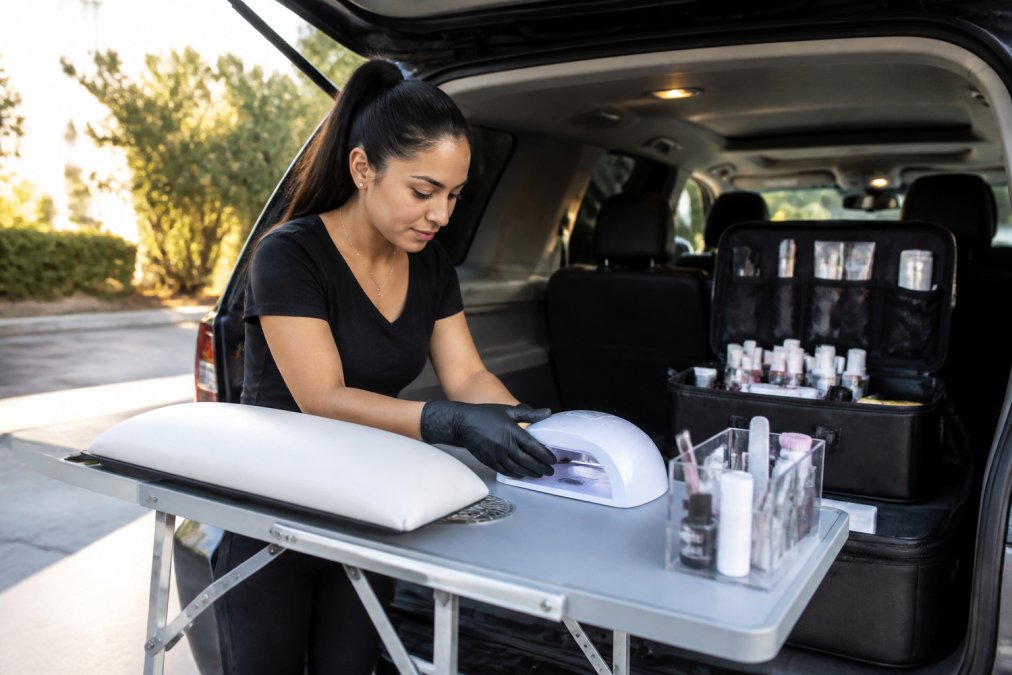
Lighting is the most overlooked element of mobile setups. Client homes rarely have the bright, even illumination of a salon. A portable LED lamp cures gel and illuminates your workspace, but you may want a separate task light positioned to eliminate shadows on the client's hands.
The Client-Facing Hygiene Theater: Turn Sanitation Into a Trust-Building Ritual
Most setup guides stop at equipment placement, but the most successful mobile techs treat their setup routine as a performance that reassures the client. In a salon, clients see the autoclave and sanitized tools. In a living room, they see nothing unless you show them. This is the "hygiene theater", a visible sequence that proves you follow professional protocols.
Here's a setup sequence that works in practice:
- Unpack your sanitation kit first. Pull out a clearly labeled container holding your EPA-registered disinfectant spray, fresh paper towels, and a sealed pouch of disposable implements. Place it on the table before any product touches the surface.
- Wipe the work surface in front of the client. Even if the table looks clean, spray and wipe it down while they watch. This takes 30 seconds and sets the tone.
- Lay out your tools on a fresh towel or disposable mat. Arrange metal tools with their sterilization pouch opened in view. If you use a UV sterilizer or glass bead sterilizer, plug it in and let it run during your prep conversation.
- Open a fresh file and buffer for each client. Snap the seal audibly. This small sound signals "new, never used" more powerfully than any verbal assurance.
- Verbally narrate your process lightly. A simple line like, "I always start with a fresh set of disposables for each client," frames your routine as standard practice, not a special accommodation.
This visible ritual differentiates you from hobbyists who show up with a zippered bag and no clear system. Clients remember the tech who treated their home like a clean clinical space.
Adapting to the Client's Space Without Sacrificing Your Posture
Client homes vary wildly: a cramped apartment bathroom, a sunroom with a low coffee table, or a kitchen island with bar stools. Carry a small, foldable step stool or risers to elevate your table to the correct height in seconds. If working on a dining chair, ask the client to sit on a firm cushion to raise their hands to a comfortable level.
Keep your most-used items, files, buffer, cuticle oil, and current polish shades, within arm's reach on a small rolling cart or tool belt. Reaching across the table or standing up repeatedly breaks your flow. A simple rule: if you have to stand up to reach it, it's in the wrong place.
Sanitation Protocols for Mobile Nail Services
Sanitation protocols for mobile nail services protect your clients and your license. Without a salon's central sterilization area, you must bring your own system for every appointment. Pack a dedicated container for tools requiring disinfection, separate from your clean supply storage.
Disposable items simplify mobile sanitation considerably. Single-use nail files, buffer blocks, and cuticle sticks eliminate cross-contamination risks entirely. For reusable metal tools like cuticle nippers, carry an EPA-registered disinfectant that meets your state board's requirements for bloodborne pathogen control. The Centers for Disease Control and Prevention) publishes guidance on proper disinfection practices that apply directly to nail services.
Skipping proper sanitation between clients is the fastest way to lose your license and your reputation. Mobile technicians face extra scrutiny because services happen in uncontrolled environments. A visible sanitation routine, performed in front of the client, builds trust that keeps them returning.
How to Price Mobile Nail Services for Profit
Pricing mobile nail services requires accounting for costs that salon-based technicians never face. Your travel time, fuel, and vehicle wear are real business expenses that must be built into your rates. A common approach is to add a travel fee beyond a certain radius, or set a minimum service charge that covers your time on the road.
Calculate your baseline hourly cost by dividing monthly expenses, supplies, insurance, vehicle costs, and marketing, by your expected billable hours. This gives you the minimum charge per hour to break even. From there, add your desired profit margin and adjust based on your market.
The Full Cost Picture: Insurance, Licensing, and Vehicle Wear
Mobile techs carry a heavier fixed-cost burden than salon employees. Your pricing must cover these often-overlooked line items:
- Professional liability insurance. A policy for mobile beauty professionals typically runs between $150 and $400 per year for basic coverage, but policies that include property damage or coverage for working in client homes cost more. This is not optional, a single client injury claim can wipe out months of profit.
- License renewal and continuing education. Most states require nail technicians to renew their license every one to two years, often with a fee of $50 to $150, plus continuing education hours that may cost $20 to $50 per course.
- Vehicle costs. The IRS standard mileage rate for business use, which includes fuel, maintenance, depreciation, and insurance, is a useful benchmark (irs.gov). Many techs underprice this because they only think about the gas.
- Equipment replacement. Cordless drills, lamps, and dust collectors wear out faster with daily travel. Set aside 5% to 10% of each service's revenue into an equipment fund so you're not caught off guard when a drill dies mid-appointment.
A Pricing Model That Works: Tiered Rates + Travel Fee
A practical model used by many successful mobile techs is a tiered structure:
- Base service rate, your standard menu price for gel manicure, acrylic full set, or pedicure, set at or slightly above local salon rates to reflect the convenience you offer.
- Travel fee, a flat fee of $10 to $25 for clients within a 15-mile radius, waived for monthly bookings or multi-service appointments. Beyond 15 miles, charge $1 to $2 per additional mile.
- Minimum service charge, a floor of $60 to $80 per appointment, so a single gel manicure at a distant location still covers your drive time.
This structure is transparent and easy to communicate. Publish your travel fee on your booking page so clients know upfront, surprise fees are the fastest way to lose a repeat customer.
Power, Weight, and Ergonomics: The Logistics Competitors Ignore
Most guides treat mobile nail equipment as a simple shopping list, but the physical logistics of transporting and powering that equipment determine whether your business survives. Battery-powered tools eliminate the need to scout for outlets in client homes, which is why the Niko Precision Power Control Cordless UV LED Nail Lamp stands out for reliable gel curing anywhere.
Weight management is equally critical. A fifty-pound kit is exhausting to haul up apartment stairs and through office lobbies daily. Prioritize cordless, compact versions of essential tools, and leave rarely used items at home rather than carrying them "just in case."
Ergonomics extend beyond the kit to your posture during service. A table set at the wrong height forces you to hunch over your client's hands, leading to back and neck strain. Choose an adjustable table that positions the client's hands at a comfortable working height whether they sit on a couch or a dining chair.
Insurance and Legal Requirements for Mobile Nail Businesses
Operating as a mobile nail technician carries distinct insurance and legal requirements that differ from salon employment. Most states require an active cosmetology or nail technician license, and some jurisdictions impose additional permitting for home-based or mobile businesses. Check with your state's cosmetology board for specific rules.
Professional liability insurance is not optional for mobile work. Your homeowner's insurance does not cover business activities, and a client injury in their home could result in a lawsuit that ends your business. Look for policies specifically designed for mobile beauty professionals that cover services performed at client locations. The Small Business Administration) provides an overview of the insurance types small business owners should consider.
Conclusion: Start With a Kit That Supports Your Growth
The transition to mobile nail services succeeds when your equipment works with you, not against you. Invest in professional-grade tools that survive daily travel, build a sanitation system you can execute consistently, and price your services to cover the real costs of working on the road. Getting these fundamentals right from the start is easier than retrofitting your kit after months of frustration.
Beauty Zone Nail Supply stocks the professional-grade equipment mobile nail techs rely on, from cordless drills and UV LED lamps to dust collectors and color starter kits. All products are intended for licensed professional use, with overstock deals and monthly specials that help you stock your kit without overspending. Shop the collection and build a mobile setup that keeps your clients coming back.
Frequently Asked Questions
What do I need to start a mobile nail business?
To start a mobile nail business, you need a reliable vehicle, a portable manicure table, comfortable seating for you and your client, and a starter kit that includes a professional LED lamp, an electric nail drill, a dust collector, and a full range of gels, polishes, and acrylics. Don't forget sanitation essentials like disinfectants, disposable files, and antibacterial wipes. You'll also need business insurance and any local licenses required in your area.
What is the best beginner nail tech kit?
The best beginner nail tech kit includes a cordless UV LED lamp, like the Niko Precision Power Control, a rechargeable electric nail drill, such as the Monika model, and a dust collector to keep the workspace clean. Look for a kit that offers a variety of gel polishes or dip powders, like the Kiara Sky Color Starter Kit, so you can practice different techniques without buying extra supplies. Prioritize quality tools that will last.
How much should I charge as a beginner mobile nail tech?
As a beginner mobile nail tech, pricing depends on your location, experience, and the services you offer. Research local rates and factor in your travel time, product costs, and overhead. A common approach is to start slightly below the market average to attract your first clients, then raise your prices as you build a portfolio and gain referrals. Always include a travel fee or minimum service charge to protect your profit margins.
How do I organize my mobile nail technician kit for travel?
Organize your mobile nail technician kit by category: use a sturdy, compartmentalized case for tools and a separate bag for products. Keep your most-used items, like files, buffers, and cuticle nippers, in a small pouch for quick access. Use airtight containers for liquids to prevent spills and label everything clearly. Invest in a quality trolley case with wheels to reduce strain and make transport easier.
What are the sanitation requirements for mobile nail techs?
Mobile nail techs must follow state board sanitation regulations, which typically require disinfecting all non-porous tools between clients, using disposable items like files and buffers, and washing hands before and after each service. Use an EPA-registered hospital-grade disinfectant and store clean tools in sealed pouches. Always dispose of single-use items properly and maintain a clean, organized workspace to prevent cross-contamination.
How do I choose the right portable LED lamp for my mobile kit?
Choose a portable LED lamp that is lightweight, cordless, and has a reliable battery life. The Niko Precision Power Control Cordless UV LED Lamp is a great option because it offers professional curing without the need for an outlet. Ensure it has a timer and automatic sensor for consistent results. Check compatibility with your gel polish brands to ensure proper curing.
Starting a mobile nail business comes with real challenges around equipment, logistics, and legal compliance. The right starter kit removes those barriers so you can focus on delivering exceptional service. Get started with Beauty Zone Nail Supply and equip your mobile business with tools built for the road.