

Professional Nail Supply Online Ordering Guide
Table of Contents
- Why Nail Supply Ordering Online Beats the Local Runaround
- Wholesale Nail Supplies for Professionals: What You Qualify For
-
Step-by-Step: How to Place an Order for Nail Supplies Online
- Step 1: Set Up and Verify Your Professional Account
- Step 2: Confirm Your Pricing Tier Before You Shop
- Step 3: Build the Cart Against Your Low-Stock List
- Step 4: Verify Authenticity Before You Pay
- Step 5: Review the Cart, Then the Costs
- Step 6: Pay, Save the Confirmation, and Track
- Calculating Total Order Cost, Shipping, and Delivery Time
- How to Choose Nail Products for a Salon Without Wasting Money
- Your Salon Nail Supply Checklist for Every Reorder
- Nail Supply Ordering Tips for Mobile Techs and Salon Owners
- Handling Returns, Damaged Goods, and Order Problems
- Conclusion: Build a Supply Ordering Routine That Never Runs Dry
- Frequently Asked Questions
Last Updated: October 5, 2026
Why Nail Supply Ordering Online Beats the Local Runaround
A professional nail supply online ordering guide saves you time, money, and the frustration of driving store to store.

Online stores carry deeper stock than any local shelf, and you can compare brands and order at midnight, no closing times, no sold-out shelves. But online ordering has traps: gray-market listings, unclear shipping costs, and license checks.
Wholesale Nail Supplies for Professionals: What You Qualify For
Wholesale nail supplies for professionals are priced for licensed buyers, not the general public. Most suppliers require proof of your license before unlocking trade pricing, a gate that protects brand integrity and keeps professional-grade products in trained hands.
License Verification and Professional Account Setup
Setup usually takes minutes: create an account, upload your license, wait for approval.
A common mistake is a blurry license photo, which gets rejected and costs you another day. Shoot it in good light with all four corners visible. Some states let you verify your license through an official lookup tool, which speeds approval.
Spotting Authorized Sourcing vs. Gray-Market Listings
Gray-market products are real products sold through unauthorized channels, possibly expired, badly stored, or counterfeit. Warning signs: prices far below everyone else's, no brand authorization statement, stock photos instead of real product images, no return policy or a vague one, and a seller who cannot name their distributor.
Authorized sellers buy directly from the brand or its approved distributor and can tell you where stock came from. If a listing avoids that question, walk away.
Step-by-Step: How to Place an Order for Nail Supplies Online
Most guides stop at "add to cart." The steps that protect your money come before checkout and after payment.
Total time: 15-30 minutes for a standard reorder, longer on your first order while your license is verified.
What you'll need: your license number and expiration date, a running low-stock list, a payment method, and your shipping address confirmed.
Step 1: Set Up and Verify Your Professional Account
Create the account with the exact legal name on your license, mismatches are the top cause of rejected verification.
Booth renters should use the salon address and note booth-rental status in the account comments. Students should check for a student tier, many suppliers offer one, with different pricing and product access.
Step 2: Confirm Your Pricing Tier Before You Shop
Log in and confirm your wholesale tier is active, you should see two prices per item: retail and your professional price. If you only see retail, verification is pending or your account is flagged. Don't order at retail hoping for a retroactive credit; call or email first.
Step 3: Build the Cart Against Your Low-Stock List
Browse by category (gel polish, acrylics, dip powder, tools, equipment), then filter by brand. Stick to lines you know perform unless deliberately testing. On each product page, check three things:
- Stock status. Out-of-stock items should go on a waitlist or a substitute list, not into a cart that will ship partial.
- Size and unit. A "case" may mean 6, 12, or 24 units depending on the brand. Confirm before you compare unit prices.
- Shelf life and lot info. If the page doesn't show an expiration or manufacture date, ask. Gel and acrylic chemistries degrade, and old stock cures inconsistently.
Step 4: Verify Authenticity Before You Pay
This is the step almost no guide covers, and where gray-market sellers get you. Before checkout, run this check:
- Authorized-dealer statement. The site should say it is an authorized retailer or distributor for the brands it sells. If it can't name its distributor, treat that as a red flag.
- Real product images. Stock photos pulled from the brand's site are a warning sign. Authorized sellers usually photograph their own inventory.
- Batch and lot codes. Legitimate professional products carry batch codes on the bottle or box. If a listing shows no lot information and the price is far below everyone else's, walk away.
Step 5: Review the Cart, Then the Costs
Review the cart against your low-stock list one more time, skipping this causes mid-week shortages. Then check the cost stack before paying: subtotal, shipping, sales tax for your delivery state, handling fees on oversized or hazmat items, and any unmet order minimum.
Step 6: Pay, Save the Confirmation, and Track
Pay with a method that gives you a dispute path, a credit or business card, not a peer-to-peer transfer.
Tracking usually arrives within one business day. If the carrier shows no movement more than two business days past the ship date, contact the supplier before the delivery window closes, most policies require reporting non-delivery within a set number of days.
Calculating Total Order Cost, Shipping, and Delivery Time
Your cart total is not your final cost. Add shipping charges (unless you clear the free shipping threshold), sales tax based on your delivery state, handling fees on oversized equipment or hazmat items, and rush shipping if you need it fast.
| Cost Factor | What It Depends On | How to Control It |
|---|---|---|
| Shipping | Order weight, dimensions, and speed | Order above the free shipping threshold |
| Sales tax | Your delivery state and local rate | No control; budget for it |
| Handling | Oversized or hazmat items | Group equipment orders together |
| Order minimum | Supplier's wholesale floor | Combine with a salon-mate's order |
| Rush fees | Delivery speed chosen | Order earlier instead of paying rush |
To estimate landed cost per unit: take the item price, add its share of shipping and tax, and divide by the units in the case. That number, not the sticker price, is what you compare across suppliers.
Standard ground shipping usually takes a few business days.
How to Choose Nail Products for a Salon Without Wasting Money
The fastest way to waste money is buying full-size products you've never tested.
Then follow these rules:
- Test in small sizes first. Buy the smallest available size before committing to a case.
- Match your lamp to your gel system. A gel line performs best under the lamp it was formulated for.
- Check cure times. Some lines need 30 seconds, others 60. Plan your service timing around it.
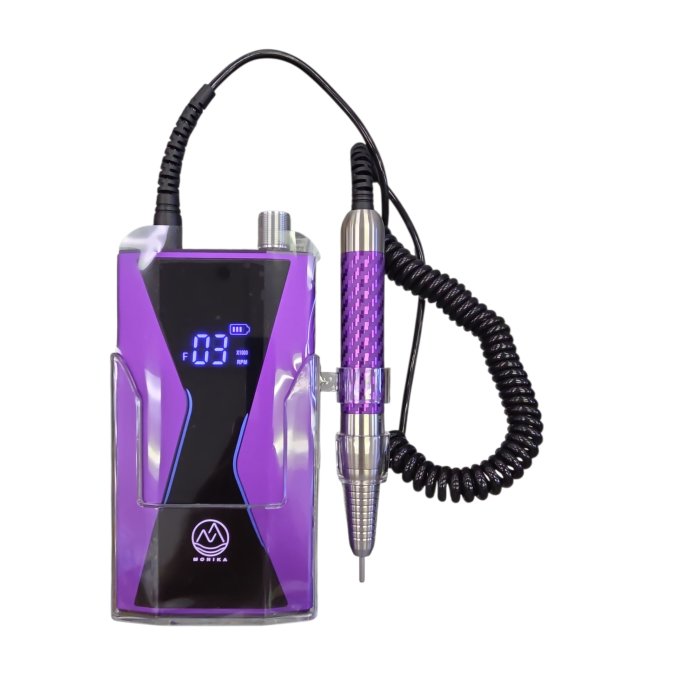
That last point matters more than people expect. A dependable machine like the Urawa Kupa Upower UP200 Nail Drill runs up to 20,000 RPM with forward and reverse modes and a stainless steel handpiece, with a one-year limited warranty.

For techs who want cordless freedom, the Monika Rechargeable Electric Nail Drill Machine up 35K reaches 35,000 RPM with adjustable speed. And for curing, the Monika LED/UV Advanced Cordless Lamp 72 W runs up to 12 hours wirelessly on a full charge, with timer settings at 10, 30, 60, and 99 seconds.
Urawa Kupa Upower UP200 Nail Drill May Tim & Hand piece UG12 →

One caution: don't switch every brand at once. Change one product line at a time so you can tell what's working.
Your Salon Nail Supply Checklist for Every Reorder
A salon nail supply checklist turns guesswork into a routine. Print it, tape it inside a cabinet, and update as you go.
Core Tools and Equipment Every Tech Needs in Stock
- Base coat and top coat (at least two bottles each)
- Gel polish in your top ten client colors
- Nail drill and a spare handpiece
Check stock every Friday. Anything below your trigger number goes on the list, then place one combined order instead of five small ones.
Nail Supply Ordering Tips for Mobile Techs and Salon Owners
For mobile setups:
- Choose starter kits and smaller bottle sizes over cases
- Store liquids upright in a sealed bin
- Keep a "car kit" and a "home stock" separate
Salon owners should think in par levels, the minimum quantity you want on hand before reordering.
Educators and students need real professional-grade products, not consumer kits, because students learn on the tools they'll use in the field.
And if you've used the same brands for years, you don't have to switch.
Handling Returns, Damaged Goods, and Order Problems
Problems happen. What matters is how fast they get fixed, and how well you documented the issue before opening the box. The difference between a fast replacement and a denied claim is usually the evidence captured in the first ten minutes after delivery.
Inspect and Document Before You Use Anything
Open the shipment in a well-lit area and inspect before shelving anything. Check each item's seal, lot code, expiration date, and bottle or jar for cracks or leakage. If something is wrong, photograph it before opening or using the product:
- A wide shot of the entire shipment as it arrived
- A close-up of the damaged or incorrect item
- A shot of the packing slip with the order number visible
Keep the box and packing materials until the claim is resolved, carriers and suppliers often require original packaging, and discarding it can void your resolution.
Report Within the Window, and Know What the Window Is
Most suppliers set a short reporting window for damage and shortages, commonly a few days after delivery, and a longer window for unopened returns. Read the policy before you order.
When you contact the supplier, lead with facts: order number, item names, what's wrong, and the resolution you want.
Match the Remedy to the Problem
Not every issue gets the same fix. Here's how to ask:
- Damaged in transit. Ask for a replacement or a full refund including shipping. The carrier, not you, should absorb the loss.
- Wrong item shipped. Ask for a prepaid return label and the correct item shipped at no cost to you.
- Missing item from a multi-item order. Ask for the missing item to ship separately, or a partial refund if you no longer need it.
Escalate When the First Response Stalls
If the first reply is a brush-off or you get no response within the stated time, escalate in writing. Reply to the same ticket to keep history in one thread, state the timeline, restate the remedy, and give a deadline.
If the supplier won't resolve it, you have options:
- Credit card chargeback. If you paid by card and the supplier won't make it right, your card issuer's dispute process is the strongest lever. Keep your photos, emails, and the order confirmation.
- Marketplace or platform dispute. If you bought through a third-party marketplace rather than the supplier's own site, use that platform's resolution process.
- Consumer protection resources. The Federal Trade Commission's guidance on online shopping and refunds explains your basic rights when an order goes wrong, and your state attorney general's consumer protection office can take complaints.
Log Every Issue
Keep a simple log: date, order number, item, problem, resolution, and days-to-resolve. After a few months, patterns show up, a brand with recurring lot problems, a carrier that damages hazmat shipments, a supplier that ships partial orders. That log is your evidence for switching suppliers, and the reason a good reorder routine includes a five-minute review of last month's issues before the next order.
A claim is only as strong as its paper trail. Photograph first, report inside the window, and escalate in writing, that sequence resolves almost every order problem.
Conclusion: Build a Supply Ordering Routine That Never Runs Dry
Running out of top coat on a Saturday afternoon is solvable with a system: one supplier, one checklist, one order day each month.
Beauty Zone Nail Supply is built for licensed professionals who want exactly that.
Get started with Beauty Zone Nail Supply and build a reorder routine your salon can actually rely on.
Frequently Asked Questions
How do I know the nail products I'm ordering online are authentic and not gray-market?
Buy only from suppliers that require a cosmetology or nail technician license before checkout. That requirement filters out most resellers moving diverted stock. Check that product listings name the manufacturer, show the original packaging, and match the brand's official item numbers. Avoid listings priced far below standard wholesale rates with no explanation, and skip sellers who cannot confirm where their inventory ships from. A reputable supplier will tell you plainly which brands it is authorized to carry.
What should I check before placing an order for professional nail products online?
Confirm four things: your license is on file with the supplier, the item numbers and sizes match what you normally use, the order minimum or free shipping threshold is met, and the stated delivery window fits your schedule. Also verify the return policy covers unopened products and damaged shipments. If you are ordering a gel or acrylic line you have not used before, buy one unit first rather than a full case.
How can I avoid ordering the wrong nail products or sizes online?
Write down the exact item number from your last empty bottle or container before you shop, and search by that number instead of by name. Product names repeat across lines, and sizes vary between 0.5 oz and 2 oz bottles even within one brand. For drill bits, note the shank size your handpiece accepts. Keep a running list of your standard items so reorders take minutes instead of guesswork.
What nail supplies should a professional nail technician keep in stock?
At minimum: base coat, top coat, gel polish in your top ten client colors, acrylic powder and monomer, dip powder in core shades, primer, bonder, nail files in 180 and 240 grit, buffers, cuticle nippers, pushers, and lint-free wipes. For equipment, keep a backup electric file and a curing lamp. Track how long each item lasts and reorder when you hit roughly two weeks of remaining supply so a shipping delay never leaves you short mid-week.