

Professional Nail Supplies for Mobile Technicians: 2026 Guide
Table of Contents
- What Makes Mobile Nail Supplies Different
- Starter Kits for Mobile Nail Technicians: What to Buy First
- Mobile Nail Tech Equipment Checklist: Core Tools That Travel
- Sanitation Requirements for Mobile Nail Services
- Portable Furniture and Packing Systems That Protect Professional Nail Supplies
- Mobile-Specific Logistics: Power, Insurance, and Legal Compliance
- Conclusion
- Frequently Asked Questions
Last Updated: September 20, 2026
What Makes Mobile Nail Supplies Different
Professional nail supplies for mobile technicians are not salon supplies packed into a car. They are chosen for portability, durability, and salon-quality results in a client's living room, office, or event venue. At Beauty Zone Nail Supply, independent techs ask one question: how do you build a kit that travels without sacrificing results?
Starter Kits for Mobile Nail Technicians: What to Buy First
A starter kit for a mobile nail technician should cover one complete manicure and one complete pedicure before variety. Buy the tools that finish a service, then expand into gel or acrylic lines once clients request them.
Here is the order most successful mobile techs follow:
- One reliable electric nail drill. A rechargeable unit with a 3/32-inch bit system handles filing, surface work, and cuticle prep. The Monika Rechargeable Electric Nail Drill File up 35K runs at 35,000 RPM with adjustable speed and a powder switch at $45.00, a sensible first drill for a new mobile tech.
- A backup or upgrade drill. Once your schedule fills, a second unit prevents a dead battery from cancelling appointments. The Monika Rechargeable Electric Nail Drill Machine up 35K #K902 offers the same 35,000 RPM ceiling with a Type-C 5V2A charging input for $70.00.
- Application implements. Cuticle nippers, pushers, brushes, and files and buffers in coarse through fine grits.
- One gel system and one acrylic or dip system. Choose the line you were trained on; adding a second chemistry before paying demand is the most common money-waster in mobile work.
- A portable curing lamp. The Onail Nail Lamp AI New Digital With Battery Included uses 109 dual-wavelength LEDs at 365nm and 405nm and includes a battery, so it needs no outlet. It is listed at $239.00.
Mobile Nail Tech Equipment Checklist: Core Tools That Travel
A mobile nail tech equipment checklist follows one rule: if you cannot replace it mid-week, carry a spare. Consumables and small implements fail at the worst moment, usually during a client's lunch break.


| Category | Item | Why It Travels | Mobile Weight & Ergonomics Notes |
|---|---|---|---|
| Prep | Cuticle nippers, pushers, nipper sharpener | Manicure and pedicure prep on every service | Full-jaw nippers are heavier than half-jaw; half-jaw is easier on the wrist across a full day |
| Filing | Files and buffers, coarse to fine grit | Shaping and finishing natural nails | Disposable files cut carry weight and eliminate a disinfection step |
| Drill | Rechargeable drill, spare bits, carbide bits | Surface work and cuticle area refinement | Cordless units remove the trip-hazard cord; keep the handpiece under roughly 6 oz to reduce wrist fatigue |
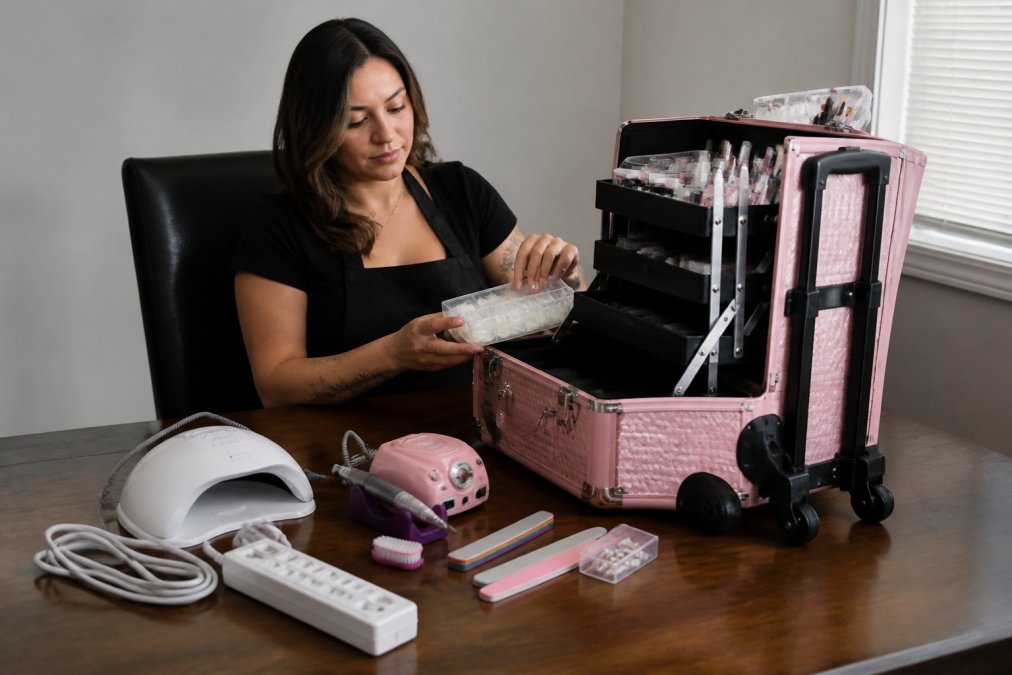
| Curing | Portable lamp, extension cord, spare bulbs | Gel and UV gel polymerization | A battery lamp is the single biggest setup-time saver; corded lamps force you to negotiate outlet access |
| Chemistry | Acrylics, dipping powders, UV gels, polish | Core service products | Decant monomer and large polish bottles into smaller travel containers to cut ounces |
| Art | Nail art tools, brushes, dotting tools | Add-on services and upsells | A slim roll pouch beats a hard case for brushes; brushes are the most fragile item you carry |
| Protection | Disposable supplies, gloves, masks | Client safety and sanitation | Nitrile gloves and masks are light but bulky; flat-pack them |
| Power | Extension cord, power strip, spare batteries | Venues with limited outlets | A 25-ft 14-gauge cord covers most rooms without voltage drop on a 35K drill |
What to weigh before you buy
Weight is the hidden cost of mobile work. A rolling case, folding table, lamp, and drill can push past 40 pounds, lifted several times per day. Two lighter trips beat one heavy trip, because an overloaded case is how backs get hurt and handpieces get dropped.
Ergonomic strain is a real line item
Mobile techs sit at whatever table the client owns, rarely at the correct height. A folding manicure table with adjustable legs, or a portable riser, brings the surface up to your forearms instead of hunching for two hours. Neck and lower-back strain is the top complaint among full-time mobile techs, and a $60 riser is cheaper than a chiropractor.
Spares that actually earn their space
Two items deserve special attention. A battery-powered portable lamp removes dependence on the client's outlets, which matters in older homes and offices. A spare drill handpiece is not a luxury once you book back-to-back appointments; one failed unit can cost a full day of income.
Sanitation Requirements for Mobile Nail Services
Sanitation requirements for mobile nail services follow salon principles, but the logistics are harder without an autoclave room or utility sink. Most state cosmetology boards require reusable implements be cleaned then disinfected with an EPA-registered hospital-grade disinfectant, and single-use items discarded after each client.
Portable Furniture and Packing Systems That Protect Professional Nail Supplies
Portable furniture and packing systems solve one problem: getting professional nail supplies from your vehicle to the client's table without damage, and back out in under ten minutes.
Mobile-Specific Logistics: Power, Insurance, and Legal Compliance
Power, insurance, and legal compliance are where mobile nail technicians get into trouble, and none are covered by standard supply advice. No product page teaches this, and it is where the difference between a hobby and a business lives.
Power: plan the circuit, not just the cord
Start with power. Confirm your client has a working outlet near the service area before you arrive, and carry a 25-foot 14-gauge extension cord plus a power strip so you never stretch a cord across a walkway. Gauge matters: a thin 16-gauge cord on a long run can drop voltage enough to slow a 35,000 RPM drill or flicker a curing lamp.
Insurance: the off-premises gap
Insurance is the bigger gap. A standard salon liability policy may not cover off-premises services, so ask your insurer directly whether it covers mobile appointments and what it requires for client consent and documentation. Many mobile techs also carry a separate business policy for vehicle and equipment, since a general auto policy typically excludes business use and tools in transit.
Legal compliance: license, permit, and intake
On the legal side, verify three things before your first mobile booking: your state license permits off-premises services, your local jurisdiction does not require a separate mobile or itinerant permit, and your intake process captures a signed consent and health history. Requirements differ by state and municipality, so confirm with your state board and local health department rather than another tech's experience.
Workflow logistics: setup time is the real budget
Setup and breakdown time is unpaid, so treat it as a cost. A realistic mobile appointment is 15 to 20 minutes of setup, the service, and 10 to 15 minutes of breakdown and repacking, a two-hour service is really a two-and-a-half-hour block, and your pricing should reflect it.
A few habits shave real minutes off every visit:
- Pre-stage the case the night before so you are not hunting for a bit at the client's door.
- Ask the client to clear a table and a chair before you arrive, and to have a trash bag ready.
- Keep a small "dirty" bin sealed inside the case so used implements never touch clean ones on the way home.
- Park where you can roll the case to the door rather than carrying it up steps.
Documentation that protects you
Keep a simple per-client record: date, service, products used, implements disinfected, and any adverse reaction. If a client raises a complaint, this log is your defense, and it doubles as your restock list by showing which chemistry is actually moving.
Conclusion
The hardest part of going mobile is not finding clients. It is building a kit that stays professional-grade while fitting in a car, and keeping licensing, insurance, and sanitation defensible while you do it.
Frequently Asked Questions
What are the essential supplies for a mobile nail technician?
A mobile kit needs a portable nail drill, UV/LED lamp, manicure and pedicure hand tools like cuticle nippers and files, acrylics or UV gels for extensions, buffers, brushes, disposable supplies, and sanitation items such as hospital-grade disinfectant. You also need a portable manicure table or rolling train case, an extension cord, and a portable lamp with a battery so you can work without a nearby outlet. Start with a starter kit for mobile nail technicians to cover the core items, then add specialty products as your client base grows.
How do mobile nail techs maintain sanitation requirements for mobile nail services?
Follow state board rules for your license: clean and disinfect reusable implements with an EPA-registered hospital-grade disinfectant, use disposable files and buffers where required, and keep a covered container for soiled tools. Bring hand sanitizer, gloves, and fresh towels for each client. Never reuse porous items between clients. Pack a separate sealed bag for dirty tools so they never touch clean supplies in transit. Document your disinfection routine in case an inspector asks during a home visit.
Where can I buy professional nail supplies online for mobile work?
Buy from a licensed professional supplier that carries authentic brands and ships fast. Beauty Zone Nail Supply stocks acrylics, gels, dip powders, and salon equipment for licensed techs, with curbside pick-up and case deals that lower your per-unit cost. Order smaller sizes or starter kits if you run a mobile business out of your car and cannot store bulk inventory. Confirm the supplier only sells to licensed professionals so you know the products are authentic, not gray-market stock.
What should I pack in a mobile nail tech equipment checklist?
Your checklist should cover three groups: tools (nail drill, bits, cuticle nippers, files, buffers, brushes), products (acrylics or dip powders, UV gels, nail polish, primer, top coat), and support gear (portable lamp, extension cord, portable manicure table, rolling train case, disposable supplies). Add sanitation items, gloves, towels, and a small client consultation sheet. Keep a printed checklist in your case so you never leave for a job missing a core item, and restock after every appointment.
U.S. Small Business Administration guide to state business licenses
U.S. Food and Drug Administration information on cosmetic products