
How to Spot Fake Nail Supplies: 2026 Pro Guide
Table of Contents
- Why Fake Nail Supplies Are a Serious Risk for Your Salon
- How to Spot Fake Nail Supplies: 7 Checks Before You Buy
- FDA Nail Product Safety Regulations: What Labels Must Tell You
- How to Verify Authorized Nail Supply Distributors
- Professional Grade vs. Consumer Grade: Why the Price Gap Matters
- What to Do If You've Already Bought Counterfeit Supplies
- Frequently Asked Questions
Last Updated: September 11, 2026
Why Fake Nail Supplies Are a Serious Risk for Your Salon
Counterfeit nail products have become harder to identify, and the consequences land on your clients, not the seller. This guide from Beauty Zone Nail Supply walks through how to spot fake nail supplies using seven verifiable checks, so you can protect your license, your clients, and your inventory before a single bottle touches a workstation.
The stakes are higher than a wasted reorder. Fake products often skip the safety testing that legitimate manufacturers perform, which means unlisted chemicals can end up in direct contact with skin and nail beds for weeks at a time. Below, we'll show you exactly what to inspect, what counterfeiters get wrong, and what to do if a bad batch already made it into your stock.
Allergic Contact Dermatitis and Other Dermatological Reactions
Allergic contact dermatitis is an immune reaction that develops after repeated skin contact with an allergen, producing redness, swelling, itching, and sometimes blistering around the nail bed and fingertips. It rarely appears after one service. It builds over weeks of exposure, which is why technicians often blame a new primer or prep step instead of the product that actually changed.
Symptoms to watch for in clients:
- Itching or burning during or shortly after application
- Redness and swelling around the cuticle and lateral folds
- Dryness, cracking, or peeling skin on the fingertips
- Nail plate lifting or separating from the nail bed
A common mistake is treating these as isolated irritation and continuing the same product line. If a client reacts, stop using that batch immediately and document the product name, lot number, and date of first use.
Toxic Ingredients: Methyl Methacrylate and Unlisted Chemicals
Methyl methacrylate is a monomer that was removed from legitimate nail product formulations decades ago because of its link to severe skin and respiratory reactions. It still shows up in counterfeit acrylic monomer because it is cheap and cures fast. Legitimate professional acrylic systems use ethyl methacrylate instead, which behaves similarly at the workstation but carries a far lower sensitization risk.
A counterfeit bottle may list no ingredients at all, list ingredients in a language you can't verify, or copy the ingredient panel from the real product while filling the bottle with something else. Unlisted chemicals are the core danger of counterfeit nail products: you cannot manage a risk you cannot see.
How to Spot Fake Nail Supplies: 7 Checks Before You Buy
Run these seven checks in order. The first three take under a minute and catch most counterfeits before you open the box. The last four require you to open the product and compare it against a known-good bottle from the same line. Keep one verified bottle of each product you stock as a reference standard, it is the single most useful tool for spotting a fake, because counterfeiters copy the label, not the formulation.
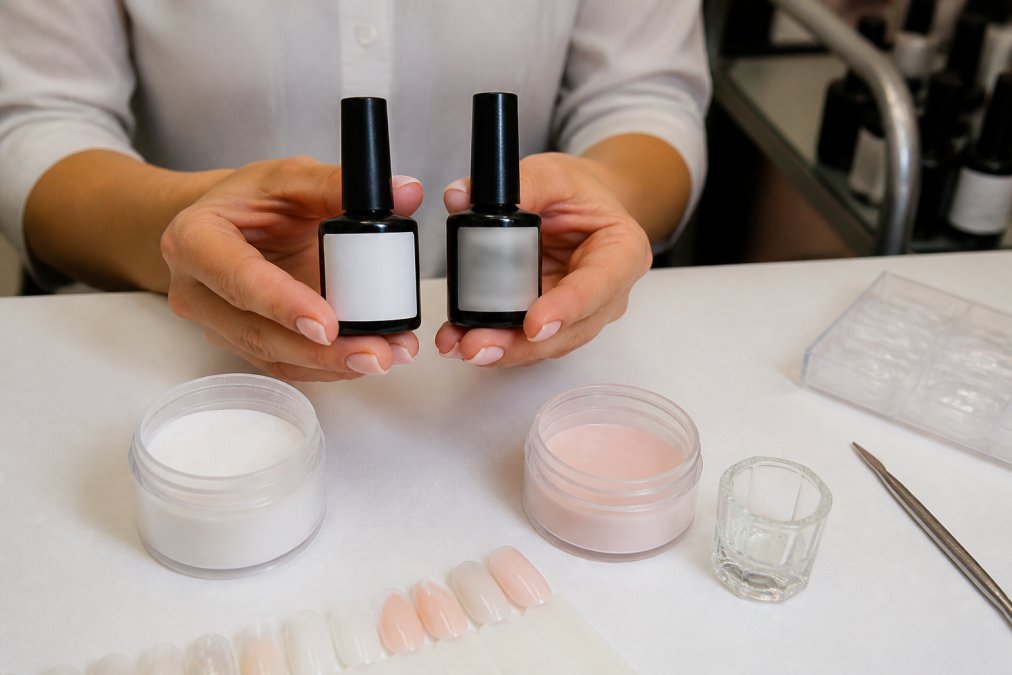
- Inspect packaging integrity. Look for a tamper-evident seal, consistent print quality, and a box that hasn't been resealed. Run your fingernail along the cap threads, glue residue or a seal that lifts in one clean sheet instead of tearing means the bottle was opened and refilled.
- Read the product labeling. Confirm the manufacturer name, address, net contents, and directions are all present and legible. A missing physical address is the fastest disqualifier; legitimate brands must list one.
- Check the batch code and serial number. Every legitimate production run carries a traceable code. Compare two bottles from the same order, identical codes across units is a red flag, not a coincidence.
- Test viscosity and curing time. Compare against a known-good bottle from the same line. Genuine gel holds a stable viscosity; counterfeit product often turns watery at the bottom and thick at the top.
- Verify UV lamp compatibility. Match the product's cure requirements to your lamp's wavelength and wattage. A gel that stays tacky past its stated cure time is not the formulation the label claims.
- Check pigment separation. Shake the bottle and watch how the pigment reincorporates. Real pigment disperses evenly within a few seconds; counterfeit pigment settles into streaks or a sludge layer that never fully mixes back in.
- Confirm shelf life. Expired product performs unpredictably even when it's genuine. A batch code you can't decode, or a date that predates the brand's current packaging, is a reason to return the order.
Why These Checks Work: The Counterfeit Supply Chain Behind Them
Most guides tell you what to look for without explaining why fakes exist in the first place. Understanding the supply chain is what turns a checklist into a judgment call.
Counterfeit nail supplies enter the market through three main channels. The first is outright mislabeling: an overseas factory produces a generic gel or acrylic, then prints a well-known brand's label and ships it through a third-party marketplace seller with no authorization. The second is diversion: genuine product that was manufactured for one market, repackaged, and sold outside its intended distribution channel, often past its intended shelf life. The third is refilling: authentic empty bottles collected and filled with a cheaper formulation, then resealed.
Each channel explains a different red flag. Mislabeled product often has slightly off label colors or a font that doesn't match the brand's current packaging. Diverted product may be genuine but expired or formulated for a different regulatory market. Refilled product shows physical tampering at the cap or seal. When a price sits far below every other seller of the same brand, one of these three channels is almost always the reason, legitimate distributors cannot undercut the brand's own pricing by a wide margin and stay in business.
A Note on Home Testing Limits
You can run simple, safe checks at home, viscosity, odor, curing time under your own lamp, and pigment reincorporation, but you cannot verify a product's full chemical profile without a lab. Treat these checks as screening tools, not certification. If a product fails two or more, stop and return it rather than trying to confirm the problem further.
FDA Nail Product Safety Regulations: What Labels Must Tell You
FDA nail product safety regulations require that cosmetic labeling identify the product, declare net contents, and list the manufacturer or distributor with a contact address, per FDA cosmetic labeling requirements. The FDA also prohibits the use of methyl methacrylate in cosmetic nail products because of its documented health risks.
What this means for your buying decision: a product missing a manufacturer name, a physical address, or a net contents declaration is not compliant, and you have no way to trace it if something goes wrong. Regulatory compliance on the label is your first and cheapest authenticity test.
How to Verify Authorized Nail Supply Distributors
Authorized nail supply distributors are sellers formally approved by the manufacturer to stock and resell their products, which means they source directly from the brand and can confirm authenticity on request. Verifying a distributor takes three steps:
- Check the manufacturer's own website for a dealer or distributor locator.
- Ask the seller for their authorization documentation before your first order.
- Confirm the seller's business address and return policy are real and reachable.
A distributor who can't produce authorization paperwork, or who deflects the question, is telling you something. So is a price that sits far below every other seller of the same brand.
Red Flags on Third-Party Marketplaces and Unauthorized Sellers
Third-party marketplaces are where most counterfeit nail supplies change hands, because listing verification is thin and sellers can disappear after a bad batch. Watch for these patterns:
- Prices well below the brand's normal retail range
- Stock photos instead of photos of the actual product
- No business address, phone number, or return policy
- Reviews that mention leaking bottles, wrong colors, or reactions
- A seller who ships from a different region than the listing claims
An unauthorized seller isn't automatically selling fakes, but they've removed the accountability chain that protects you when something goes wrong.
Professional Grade vs. Consumer Grade: Why the Price Gap Matters
Professional grade products are formulated for licensed use, with higher pigment loads, controlled viscosity, and documented cure specifications. Consumer grade products are built for occasional home use and often dilute pigment or substitute cheaper monomers to hit a lower price.
That gap explains most of the price difference you see online. When a listing undercuts professional pricing by a wide margin, the seller has cut something: pigment, monomer quality, testing, or all three. If you're comparing suppliers, compare what's actually in the bottle and whether the seller can document it.
| Check | Genuine Professional Product | Likely Counterfeit |
|---|---|---|
| Tamper seal | Intact, breaks cleanly | Missing or reapplied |
| Batch code | Unique per production run | Identical across units |
| Ingredients | Fully listed on label | Missing or copied |
| Viscosity | Stable across bottle | Separates, watery or thick |
| Cure time | Matches spec sheet | Inconsistent, tacky |
| Seller | Authorized distributor | Unverified marketplace seller |
What to Do If You've Already Bought Counterfeit Supplies
Stop using the product immediately and quarantine it away from your work area. Don't finish the bottle to "use it up," and don't sell or donate it. Counterfeit product that caused no visible reaction in one client can still sensitize another, and passing it along spreads the risk. Document what you have, then work through the two tracks below.
Document Before You Report
Before you contact anyone, build a record. This is the step most technicians skip, and it is the reason complaints stall.
- Photograph the product, the label, and the batch code in the same frame.
- Save the order confirmation, packing slip, and any listing screenshots showing the price and seller name.
- Note the purchase date, the seller's listed business name, and the shipping origin on the package.
- If a client reacted, record the product name, lot number, date of first use, and a description of symptoms.
- Keep the product itself in its original container. Do not pour it out before a complaint is filed.
Reporting Fraudulent Sellers and Filing Complaints
Different problems go to different places, and sending a complaint to the wrong one is why many never get resolved.
- Marketplace seller misrepresentation. Report the listing to the platform where you bought it. Use the "report this listing" or "report a seller" flow and attach your photos and order number. Platforms act faster on listings that include evidence of a mislabeled or tampered product.
- Deceptive pricing or advertising. File a complaint with the FTC consumer complaint system if the seller misrepresented the product's brand, origin, or contents. The FTC collects these reports and uses patterns across complaints to target enforcement, even when it does not act on a single case.
- Adverse reaction in a client. The FDA's MedWatch reporting program accepts reports of adverse events tied to cosmetic products. This is the correct channel when a client experienced a reaction, not the FTC.
- Unlabeled or misbranded cosmetic. Report the product to the FDA through its cosmetic complaint process if the label is missing required information such as the manufacturer name, address, or net contents.
Keep a copy of every complaint you file. If the seller later disputes the charge or the platform asks for follow-up, you will already have the record assembled.
Home Chemical Safety Checks and Safe Disposal
You can't test a product's full chemical profile at home, but you can run basic checks that flag a problem: confirm the safety data sheet exists, check that the label lists ingredients, and verify the batch code against the manufacturer. If the seller cannot produce a safety data sheet on request, treat that as a failed check on its own.
For disposal, seal the product in its original container, label it clearly as counterfeit or suspect, and take it to a household hazardous waste collection site rather than pouring it down a drain. Uncured monomer and gel are not safe to flush, they can harden in plumbing and the chemicals should not enter the water system. If your area does not have a collection site, contact your local waste authority for the correct drop-off option.
Frequently Asked Questions
How can I verify if a nail supply distributor is authorized?
Check the brand's official website for an authorized distributor locator, then confirm the seller's name matches. Request a certificate of authorization directly from the distributor. Authorized nail supply distributors can also provide safety data sheets and batch documentation on request. If a seller cannot or will not produce these documents, treat that as a red flag and source your supplies elsewhere.
What are the common signs of counterfeit gel polish packaging?
Look for misspelled brand names, blurry or misaligned logos, fonts that differ from the authentic version, and missing batch codes or serial numbers. Counterfeit gel polish often has no tamper-evident seal or a seal that peels off too easily. Check the label for a manufacturer address and ingredient list. If the packaging feels flimsy or the color looks slightly off from what you normally receive, it is likely fake.
Why are counterfeit nail products dangerous for salon clients?
Counterfeit products often contain unlisted toxic ingredients like methyl methacrylate, which is linked to allergic contact dermatitis and severe dermatological reactions. Unregulated formulas may have incorrect curing times, leading to under-cured gel that traps moisture and causes nail bed infections. Clients can develop permanent sensitivity to acrylics and gels, ending their ability to wear nail enhancements. Some counterfeit products also carry bacterial contamination risks from unregulated manufacturing.
How do I check if a nail product meets FDA safety standards?
Check the product label for a complete ingredient list, manufacturer name and address, batch code, and safety data sheet availability. Under FDA nail product safety regulations, cosmetics must be safe when used as directed, but the FDA does not pre-approve individual nail products before sale. That means your best protection is buying from authorized nail supply distributors who can provide documentation. If a product has no ingredient list or manufacturer information, do not use it on clients.
Counterfeit supplies will keep getting harder to distinguish from the real thing, which puts the burden on you to verify every order before it touches a client. Beauty Zone Nail Supply serves licensed professionals with products intended for professional use only, an extensive selection of professional nail brands, and case deals that make verified sourcing affordable. Get started with Beauty Zone Nail Supply and stock your salon with supplies you can trace.