
Choosing the Right Salon Curing Lamp: 2026 Guide
Table of Contents
- Why the Right Salon Curing Lamp Decides Your Service Quality
- UV vs LED Nail Lamp Differences Every Tech Should Know
- Professional Gel Nail Lamp Wattage Requirements
- Nail Lamp Curing Time Chart for Common Gel Products
- Brand Matching: Why Your Lamp and Gel Must Work Together
- Troubleshooting Under-Curing and Over-Curing
- Safety, Sanitization, and Heat Spikes in Professional Use
- Stationary vs Cordless: Which Salon Curing Lamp Fits Your Setup
- Frequently Asked Questions
Last Updated: September 19, 2026
Why the Right Salon Curing Lamp Decides Your Service Quality
A salon curing lamp determines whether a gel manicure lasts two weeks or two days, and it is the most common source of service failures in professional nail work. Technicians often blame the gel, switch brands, and still get peeling clients, when the real problem is an underpowered or mismatched lamp. The lamp controls polymerization, the reaction that turns wet gel into a hard finish.
UV vs LED Nail Lamp Differences Every Tech Should Know
UV and LED lamps both cure gel, but differently. UV lamps use fluorescent tubes that emit a broad spectrum and cure slowly, requiring tube replacement and longer cycles. LED lamps use diodes tuned to a narrow wavelength, curing faster, running cooler, and never needing bulb replacement, costing more upfront but paying back through speed and lower maintenance.
Wavelength, Nanometers, and What They Mean for Curing
Wavelength, measured in nanometers, determines whether your lamp can activate the photoinitiators inside a given gel. Most gel systems are built around a specific window, typically 365nm to 405nm. A lamp emitting outside that window leaves gel under-cured even if you run the timer twice. This is why two lamps with identical wattage can produce completely different results: wattage tells you how much power the lamp draws, wavelength tells you whether that power does anything to your product.
Professional Gel Nail Lamp Wattage Requirements
Professional gel nail lamp wattage requirements start around 36 watts for standard gel polish and climb to 72 watts and beyond for builder and hard gels. Higher wattage means faster, more even curing, but only if light is distributed across all five fingers. For most independent salons, 36W to 48W handles the majority of services; step up to 72W for thick builder gels or high-volume pedicures.

LED Array, Bulb Count, and Placement
The LED array is the arrangement of diodes inside the lamp, and placement decides whether every nail cures at the same rate. Diodes only at the top under-cure the pinky and thumb at the edges of the light field. Look for diodes on the sides and bottom as well as the top, plus reflective interiors that bounce light into corners.
| Lamp Type | Typical Wattage | Best For | Bulb Replacement |
|---|---|---|---|
| Compact LED | 36W | Standard gel polish, mobile work | Not required |
| Mid-range LED | 48W | Mixed services, builder gel | Not required |
| High-power LED | 72W | High-volume, thick gels | Not required |
| Fluorescent UV | 36W | Budget setups | Required periodically |
Nail Lamp Curing Time Chart for Common Gel Products
Curing time depends on the product, not just the lamp. A base coat cures in seconds under a strong LED, while thick builder gel needs a full cycle plus a flash cure between layers. Running everything on the same 60-second setting is a common salon mistake. As a starting framework: base coat 10 to 30 seconds, color coats 30 to 60 seconds each, builder gel 60 to 99 seconds, top coat 30 to 60 seconds.
Brand Matching: Why Your Lamp and Gel Must Work Together
Your lamp and gel must be built for each other, and the reason is chemistry, not marketing. Gel formulas contain photoinitiators, molecules that absorb light energy and trigger polymerization. Different photoinitiators respond to different wavelengths, and manufacturers select them based on the lamp the product is intended to cure under. Pairing a lamp from one brand with a gel from another runs an untested combination that may leave unreacted photoinitiator in the finished service.
Chemical Compatibility Testing Before You Commit
Test a new lamp-gel pairing on yourself before using it on a paying client. Apply the full service, cure it with the new lamp, and check at 24 hours and one week. A properly cured service shows no tacky layer after the top coat, no dulling at the free edge, and no lifting at the cuticle. If it dulls, chips, or peels in sheets, add one full cure cycle and recheck. If that fails, the wavelength or irradiance is mismatched.
Troubleshooting Under-Curing and Over-Curing
Under-curing and over-curing are specific failure modes with specific causes, and you can diagnose them in a fixed order, changing one variable at a time. Wrinkling, where the gel surface looks shriveled or rippled, almost always means the top layer cured before the layer beneath it: the surface set, the interior stayed soft, and shrinkage pulled the skin into wrinkles.
Safety, Sanitization, and Heat Spikes in Professional Use
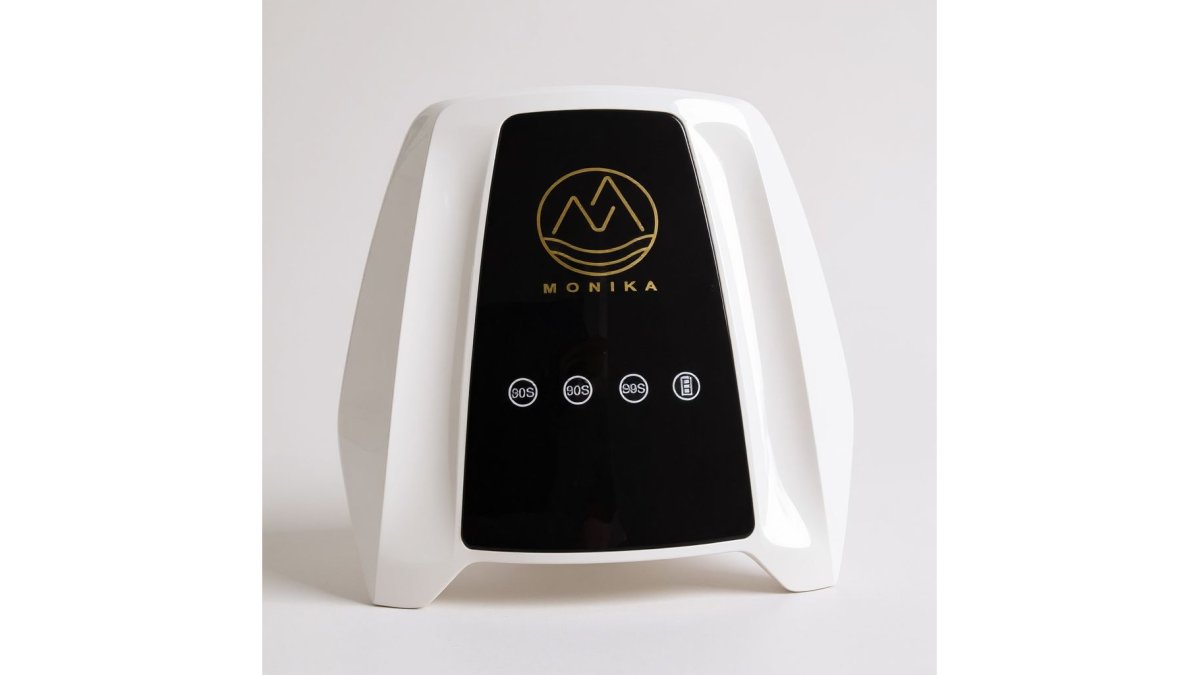
Heat spikes happen when the gel's exothermic reaction runs faster than the client can tolerate, and they are the number-one comfort complaint in gel services. Low-heat mode slows the initial cure so less heat is generated at once; lamps like the Monika LED/UV Advanced Cordless Lamp 72W, with its 99-second low-heat mode, give you control over this. Dermatological safety matters too: repeated exposure to UV and near-UV light concerns both technicians and clients, so lamps with shielding, like the patented eyeShield on the Gelish 18G Plus, limit stray light exposure.
Harmony Gelish 18G Plus LED Gel Light →

Stationary vs Cordless: Which Salon Curing Lamp Fits Your Setup
Stationary and cordless lamps serve different working styles. A stationary lamp stays on the workstation, plugs into the wall, and delivers consistent power with no battery to manage. A cordless lamp moves with you, which matters for mobile technicians and salons where one lamp serves multiple stations.

| Lamp | Power | Key Feature | Best For |
|---|---|---|---|
| Gelish 18G Plus LED | 36W | eyeShield, magnetic tray | Fixed Gelish stations |
| Monika S90 Cordless | 72W | 12-hour battery | Mobile technicians |
| CND LED Lamp | 36W | Preset step controls | Multi-service salons |
| ONAIL AI Nail Lamp | Dual-wavelength | AI nail sensing | Tech-forward salons |
| Ionica 36W LED | 36W | Compact build | Budget starter setups |
Frequently Asked Questions
What wattage is required for professional-grade gel curing?
Professional gel curing typically needs 36W to 72W, depending on the gel system. A 36W lamp like the Gelish 18G Plus handles standard gel polish and foundation coats, while a 72W cordless option such as the Monika S90 cures builder gels and thicker products faster. Match wattage to the gel manufacturer's recommendation, because higher wattage does not always mean better results if the wavelength is wrong.
What is the difference between UV and LED curing lamps in a salon setting?
UV lamps use fluorescent bulbs that emit a broad UV spectrum and need periodic bulb replacement. LED lamps use diodes that target specific wavelengths, usually 365nm and 405nm, so they cure faster, run cooler, and last far longer without bulb changes. Most modern salon curing lamps are LED, and they work with gels formulated for LED curing.
How do I ensure my salon curing lamp is compatible with various gel brands?
Check the gel's photoinitiator system against your lamp's wavelength. Most LED gels cure at 365nm or 405nm, so a dual-wavelength lamp like the ONAIL SUNX PRO (https://www.beautyzonesupply.com/products/onail-nail-lamp-ai-new-digital-with-battery-included) covers more brands. Before committing a full service, test a single cured swatch of each gel with your lamp and check for tackiness, dullness, or peeling after 24 hours.
How often should salon curing lamps be replaced or serviced?
LED lamps do not need bulb replacement, but diodes dim over years of use. Replace or service a lamp when curing times stretch noticeably longer, gel finishes feel tacky, or the timer behaves inconsistently. Wipe the reflective interior and removable tray with acetone-safe cleaner weekly to keep irradiance consistent.
Are there specific safety standards for professional nail curing lamps?
In the U.S., professional curing lamps should meet applicable electrical safety standards and carry eye protection features. The Gelish 18G Plus, for example, uses a patented EyeShield with SafeLight technology (US Patent 8,739,431) to limit light exposure. Always follow the manufacturer's skin-exposure guidance and avoid curing bare skin unnecessarily.
What features distinguish a professional salon lamp from a consumer model?
Professional models typically offer higher wattage, a five-finger cure, removable trays for sanitization, preset timer settings, and acetone-resistant surfaces. Consumer lamps often lack the irradiance consistency and duty cycle needed for back-to-back clients. If you are choosing the right salon curing lamp for daily service, prioritize timer accuracy, LED array coverage, and easy cleaning.
What is the best nail curing lamp for at-home use?
For at-home use, look for a cordless or compact LED lamp with at least 36W and adjustable timer settings. The Monika LED/UV Advanced Cordless Lamp (https://www.beautyzonesupply.com/products/monika-leduv-advanced-cordless-lamp-72-w-s90) offers 72W with a 15,600 mAh battery and 10s/30s/60s/99s low-heat modes, which suits occasional gel manicures without the footprint of a full salon unit. Match the lamp to the gel brand you use most.
How do I troubleshoot under-curing on a professional gel nail lamp?
Under-curing shows up as tacky top coats, dull finish, or gel lifting within days. Check three things: whether your lamp's wavelength matches the gel's photoinitiators, whether hand placement blocks the LED array, and whether the timer is set long enough for the product thickness. Test with a known-good gel to isolate whether the lamp or the product is the issue.